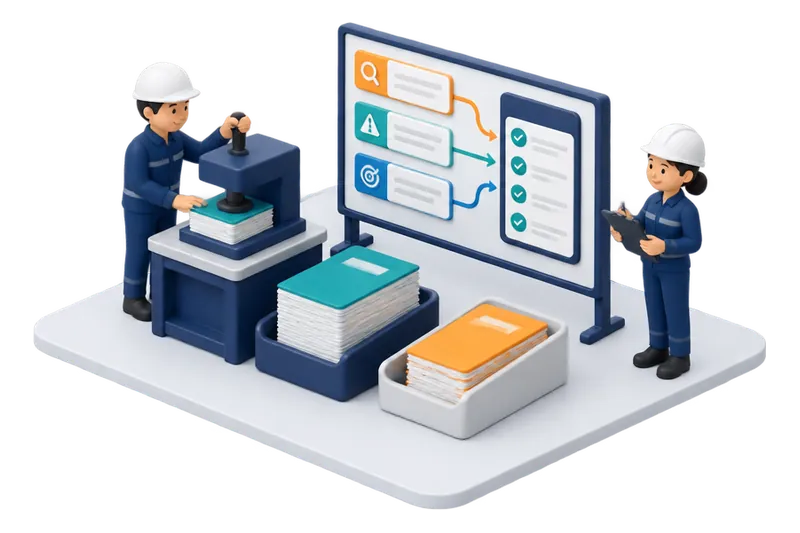
Controlled documents and revisions, nonconformities and corrective action, risk, quality objectives, management review, internal audit and official letters run in the same record structure. Actions are collected in one structure: the owner, due date and effectiveness verification are the same in every record.

The documents in force, the obsolete documents and the revision history follow from the status; earlier content stays in the history.
Actions arising from nonconformities, risks, objectives and management reviews use the same owner, due date and verification structure.
A nonconformity record and a task are opened from an internal audit finding, and no second tracking system is set up.
Which document is in force and which revision is valid.
A document is recorded with its code, title, category and owner; there are documents prepared inside the organization (manual, procedure, work instruction, form) and externally sourced ones (standard, regulation, manufacturer's manual). Documents in force make up the master list and those withdrawn make up the obsolete document list; an obsolete document can be put back in force. If a review period is given, the next review date is calculated together with the approval.
The revision number is assigned automatically and a change description is required; the approved revision becomes the revision in force and the earlier content stays in the revision history. A revision can be submitted to the approval flow and can carry a signature. A user reports the need for a change in a document as a revision request; the request is approved or rejected, and an approved request is closed when it results in a revision.
Documents reference one another, supersede one another, are attached to one another or are linked as a form. When a new revision of one end is published, the owner of the other end is informed; if the relation is marked, a review request is opened automatically for the affected document.
A public live view of the document is shared; the page always shows the current published revision, so no old copy circulates. An announcement is sent by e-mail to selected external stakeholders; when a new revision is published, an update e-mail goes to the recipients who were notified. The announcements are kept as a history that cannot be changed. A public link requires the Sharing module.
A problem, a threat and an objective are tied to the same action structure.
A nonconformity gets a number; its source is marked as internal audit, external audit, customer complaint, process monitoring, supplier or other, the related controlled document is linked and the root cause analysis is written. An action is a correction, a corrective or a preventive action; it has an owner and a due date, is completed and its effectiveness is verified. Closure can be tied to the approval flow. The record is not destroyed permanently and stays as quality evidence.
A risk is recorded by category (operational, financial, compliance, strategic, information security, occupational health and safety); probability and impact are scored and the score is their product. The existing controls are written down and the remaining risk is re-scored after the actions. A responsible unit, a risk owner and the next review date are given; closure can be tied to the approval flow.
An objective is recorded as a quality objective or a strategic plan objective; its period, unit of measure, target value and direction (increase or decrease) are given. Period-end achievement entries are added, and the achievement is calculated on the spot from the latest entry. Actions tied to the objective carry an owner and a due date.
A meeting is recorded with its date, place, participants, agenda and decisions; the minutes and attachments are added as files and signatures are collected. The actions arising from the meeting are followed with an owner, a due date and verification, and the meeting is closed as completed.
The record of a finding and the trail of an official letter.
An annual audit programme is set up, and an audit without a programme can also be opened. An audit gets a number; the scope, the audited unit, the audited facility area, the lead auditor and the team are set, and it passes through plan, fieldwork, report and closure. A finding is conforming, a nonconformity, an observation or an improvement opportunity; a nonconformity record is opened from a nonconformity finding and a task from a finding. A form can be linked to an audit as a checklist. The report can be tied to the approval flow; the report PDF falls into the document archive at closure.
An outgoing letter is produced, gets a letter number, is submitted for approval and is marked as sent; signatures are collected. An incoming document is registered by hand. A letter is referred to personnel and followed until the referral is completed. For an approved outgoing letter, a public view and a key-gated PDF are shared (the Sharing module is required); attachments and scanned documents are added to the letter. The addressee can be a defined external stakeholder or a free-text name.
Most frequently asked questions about the QMS and compliance
Yes. The approved revision becomes the revision in force, and the earlier revisions stay in the revision history.
No. If an approval scheme is defined, closure enters the approval flow; if not, the record closes directly.
The existing nonconformity record is opened from a finding of the nonconformity type; no second tracking system is set up and the source is marked as internal audit in the record.
The shared link always shows the current published revision. When a new revision is published, an update e-mail goes to the recipients who were notified.
Tell us about your document, nonconformity and audit processes and let's clarify together which module to start with.
We have your details; we will call you, taking your chosen time slot into account.
Document, nonconformity, risk, objective and audit records stay in the same structure.